Companies going through change
Leading through growth, transitions and acquisitions
In short
Some moments need an experienced leader in the room: a technology leader leaves, the team doubles, the company contracts, an acquisition is under way or delivery has stalled. I lead through those moments as a fractional or interim CTO, take responsibility for the transition, and hand over to a team that no longer needs me.
You might recognise this
- Your technology leader has left, or is about to.
- The team is growing faster than its ways of working.
- You are going through an acquisition, a merger or a contraction.
- Delivery dates keep slipping, and nobody can say why.
How we might work together
Examples, not packages. They often overlap within one relationship, and we shape the work together.
See the examples
- Fractional CTO leadership
- Part-time technology leadership, with clear ownership of decisions.
- Interim CTO leadership
- Full or near-full-time leadership while you find a permanent leader, with a proper handover.
- Turning delivery round
- Finding where work gets stuck, and changing how the team plans, builds and releases.
Relevant experience
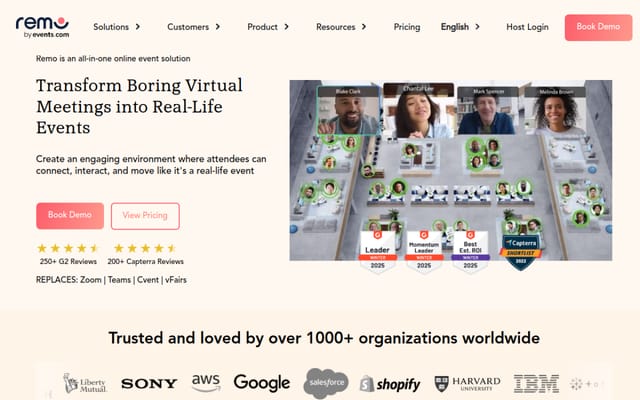
- Led Remo’s engineering through pandemic hypergrowth and contraction, and advised the CEO on an exit strategy Read the case study
- Scaled Festicket’s team from 3 to 17 through Series B and C, and reengineered the platform to support substantial increases in concurrent demand Read the case study
- Led post-acquisition IT integration at Global University Systems, serving 15,000+ students
- Cut Remo’s infrastructure and vendor spend by more than 80% over 14 months, normalised for user-hours in events, holding ~99.99% uptime during event hours Read the case study
If you were lucky enough to get someone who is technically amazing, amazing at project management, and has business sense, then I would say that you just met a unicorn. In my experience, James is a unicorn.
How we start
We start with a focused look at what you’re trying to achieve, what’s getting in the way, and how I could help. From there, we agree whether there’s a useful role for me and what it should involve.
- Understanding the business and what you are trying to achieve
- Meeting the people who matter to the work
- Looking at enough evidence to see where I could be useful
- Deciding together whether an ongoing role makes sense, and what it should be
Questions
What is the difference between fractional and interim leadership?
Fractional leadership is part-time and ongoing. Interim leadership covers a gap, full-time or close to it, and ends with a handover to a permanent leader.
Will you help hire a permanent leader?
Yes. Defining the role and assessing candidates is usually part of the work.
Further reading
How do we reduce production bugs without slowing delivery?
Start with the failures that matter to customers, then shorten the time between making a change and learning whether it works. Smaller releases, useful automated checks, clear operational signals and a workable recovery path can reduce disruption. Focus on recurring causes and feedback delays rather than adding approval steps to every change. Read the full answer
What should we do when our founding CTO or lead engineer leaves?
First establish who owns decisions, how the product will keep operating and what knowledge must be transferred. Separate immediate continuity from the longer-term leadership appointment. Give the team a clear point of contact and a realistic plan, then decide what remit and experience the next leader needs for the business’s current stage. Read the full answer
How do we know whether technical problems are affecting customers?
Observe the customer journeys that matter, not just whether servers are running. Connect product events with errors, latency and operational changes so you can see where people fail or abandon a task. Define success and failure consistently, then use those signals to investigate quality and prioritise improvements with the team. Read the full answer